|
In the Middle of Nowhere
(From Golf World September 2, 2005)
No one venturing through South Dakota this summer would
have considered Walter Keating's golf swing a tourist
attraction, at least not in the same league with Mount
Rushmore or certainly Reptile Gardens. When the longest
hitter on the Dakotas Tour pulled his driver out of the bag,
though, it was worth a peek if you were in the neighborhood.
Keating, 29, stands 6-feet-7 and weighs 255 pounds. He is
bald, left-handed and imparts some serious hurt on the ball,
the fury of his technique connoting the name of his Canadian
hometown, Thunder Bay.
It is common to lament what professional golf lacks in
these bloated-purse and buffed-golfer days--characters,
camaraderie and charm, for starters--but critics may just be
looking in the wrong place. "Real golf isn't what you see on
TV," says Tom Silva, another regular on the 16-event 2005
Dakotas Tour. "This is golf."
Silva, Keating and a dozen other golfers are at an
upstairs table at the Waterfront Gourmet Grill, a restaurant
in downtown Yankton, S.D., once the territorial capital of
the Dakotas and, this week in early August, home of the
Hillcrest Invitational Pro-Am. The 72-hole tournament, whose
$75,000 purse and $20,000 first prize are the richest on the
circuit, begins the next morning. In lieu of a routine
practice round, the American guys have just defeated an
International team in the Cockatoo Cup and now it is time to
celebrate and commiserate.
The competition was titled after the adult club of the
same name in Yankton, which can safely be presumed isn't
where the city's most famous son, Tom Brokaw, went for
milkshakes after high school in 1957. There are plenty of
beers and back-slaps, and by the time a second bottle of
Rumple Minze 100-proof peppermint schnapps has been
depleted, shot by enthusiastic shot, everyone's glass is
half-full even if it's empty. The big boys getting tucked in
to play for big money over at the International near Denver
can't be having more fun than this, can they?
Golfers don't come to the Dakotas Tour to get rich. They
come to learn shots and strategies, to both forget and
remember. "I'm not making any money, but I'm living a
dream," says Amos Rolon, a 52-year-old from Arizona, in his
seventh year in the Dakotas. Rolon sells recreational
vehicles most of the year and travels in one along the tour
with his girlfriend, Cindy Krueger, two Rotweilers and a
13-year-old African gray parrot called Kirby. "He says
‘Fore,' " Rolon says, "and I'm trying to teach him to say,
‘Pick it up, that's good.' "
Along the way the Dakotas golfers meet a lot of nice
people. A few years ago Rolon was driving through Belle
Fourche, a town north of Rapid City, when he hit a deer,
mangling the front of his truck. "It's Sunday morning,"
Rolon says. "Not only does this man open his shop and fix it
right then, he only charged me $125 for three hours' worth
of work. That doesn't happen in Phoenix. America's still
there, you just have to get off the road and find it."
A man chalks up plenty of miles behind the wheel- 1,992
this season, from the first event in Spencer, Iowa, to the
last, in Fargo, N.D., not including beer runs. "Only had one
day off in three weeks," says Chad Fribley, a 29-year-old
Oregonian who supports his competitive career working bag
rooms in Palm Springs during the winter. "You're either
playing or you're driving." Joe Ogilvie, a PGA Tour player
who launched his pro career in the Dakotas in 1996 after
graduating from Duke, found out quickly this tour wasn't
like so many developmental tours that are tethered to one
locale. "Somebody would give you directions, and they'd say,
‘Take a left at the first light and then take your next
right,' " Ogilvie recalls of his Dakotas experience. "You'd
ask how far it was to the first light, and they'd say,
‘About 90 miles.' "
A PROVING GROUND for some and a fantasy camp for others, the Dakotas
Tour is a loosely woven tapestry of tournaments from 18 to
72 holes. Nearly every one is a pro-am, making them more
social occasions than many minor tours where it is just a
man, his cart and his consternation about being able to win
back his entry fee. "You have to be polite even if you're
cranky," Keating says of the amateurs' presence, and he
isn't shy about reminding any newcomer who forgets where he
is. Among the 180 amateurs at Hillcrest was 49-year-old Pat
McFate, who made the 430-mile drive from Muscatine, Iowa,
with a handful of his friends. McFate has been playing at
Hillcrest G&CC's gathering for 22 years. When his sons got
old enough, they started playing, too. McFate considers the
$250 amateur entry fee a bargain for three days of golf
(four, if you make the cut) and all the trimmings, and he
figures his share of a modest motel on Tom Brokaw Boulevard
is about $12 a night.
The director of the Dakotas Tour is 79-year-old Bill Branson, who
spends his mornings working behind the counter at the
Hillcrest pro shop and is still spry enough to shoot his
age. A Nebraska native, Branson settled in Yankton after
moving there to play semipro baseball in the early 1950s,
and ran a bowling alley on the edge of town for 20 years. He
has been a clearinghouse for the tour since the late 1990s,
but each event--the seven 54- or 72-hole tournaments are
called "majors"--is run locally.
Entry fees (ranging from $125 for a one-dayer in Groton,
S.D., to $650 at Hillcrest) are á là carte; players can play
in as many or as few tournaments as they want. Many golfers
seek free lodging in local homes to keep down costs.
"Private housing makes this tour," says Steve Hale, a
25-year-old from Michigan City, Ind., just beginning his pro
career. "I didn't want to burn through a lot of money right
away. I'm down [financially] for the year, but this tour
teaches you how to deal with the travel and the different
courses."
A dozen or so golfers play the entire tour ("Play for
over $413,625 in 51 days,", a pamphlet boasts), a larger
group plays most of the tournaments, and some cherry-pick
the most lucrative stops: Yankton, Vermillion and Rapid
City, S.D., plus Minot, N.D. Branson says, "I tell [the
players] many times: We're awful glad to have you here. We
hope you come back, but we're pulling for you to make it to
the next level. We're just a starter level."
In contrast to the PGA Tour, post-round convention is
more likely to include Coronas than a Cybex machine, but the
Hillcrest practice range wasn't a ghost town. You could find
a cancer survivor (Stuart Hendley, who conducted a
pre-tournament clinic), a former commercial fisherman (James
McCarthy, whose County Cork roots means that everyone calls
him "Irish") and a high school math and science teacher (Jay
Jurecic, who was preparing to return to the classroom in
Caspian, Mich., after a two-year leave during which he
played full time).
"It's a great tour for the money," says the 35-year-old
Jurecic, pausing during a practice session by his small
carry bag. "If you play all the events, it costs $7,000 or
$8,000. It's fun playing with the ams, and you get to stay
with families." Jurecic is one of the hard workers on the
Dakotas Tour, the kind of fellow you'll see testing his golf
grip on a water bottle and checking his takeaway in the
locker-room mirror.
This was the 20th year for the Dakotas Tour, but a few of
the events have been around much longer. Rapid City's
tournament, the Arrowhead Pro-Am, has been contested since
1966. "We had 13 pros the first year, and the winner got
$750," says Arrowhead CC member John Derby, who organized
the inaugural tournament and ran it for many years.
Hillcrest's event, spearheaded by a local meat-packing owner
named Laddie Cimpl, began in 1974. Cimpl's fellow Hillcrest
members were quick to embrace the idea.
"We started out with red jackets [for the committee] then
went to green," says Jim Cihak, who runs an insurance
agency. "We thought we were as good as Augusta.
Unfortunately, some of us have outgrown them."
Cihak is talking amid the spirited calcutta wagering at
the Hillcrest clubhouse the night before the first round.
There are green jackets sprinkled around the room as
auctioneer Bill Bobzin offers up the 60 teams, his
rapid-fire delivery barely slowing even as his voice
protests from the strain. One member spends more than $2,000
buying five groups, and $26,000 is in the kitty by night's
end. They'll wager another $16,000 after the second round,
and more on the nightly skills competitions. This might not
be the big time, but in Yankton the Pro-Am is a big deal.
SILVA SAMPLED THE big time once. He played golf at San Jose State in
his native northern California and got through Q school in
1989. But he wasn't able to play much or well as a PGA Tour
rookie in 1990. He got only four starts in the first four
months of the season, and like a kid at a carnival shooting
gallery, the experience went too quickly. "It seemed like I
was just getting my feet wet, and it was over," says Silva,
who made one cut, at the B.C. Open, in 14 appearances.
He gave up his PGA Tour dreams for most of the 1990s, but
by 1998 was ready to try again. After earning more than
$100,000 playing mini-tours that year, he advanced to Q
school finals at La Quinta, Calif. With only nine of the 108
holes remaining, Silva was within the cut line and poised to
succeed. Then he triple-bogeyed the 10th hole and failed by
one stroke. Something inside died that day, and he teaches
in the California desert now and has played in the Dakotas
the last few summers, a little for the past, a little for
the future, but mostly for fun.
"Five years ago I had about $500 to my name and won a
tournament in Minot," says Silva. He was in a small motor
home then and used part of his winnings to buy a yellow
labrador named Simon, who was keeping him company at his RV
in Yankton, where he parked with Rolon and Keating in back
of the Fox Run municipal course.
Silva's work has resulted in a deep, bronze tan, the kind
people used to seek years ago when they lathered on
Coppertone oils with no fear of the sun. Now 42, he plays in
sneakers because they make his fickle back feel better.
Stretching before his first swing of the tournament, Silva
looks stiff but swings smoothly, his taut action delivering
a perfect drive down Hillcrest's 10th fairway. Ignore the
tennis shoes and you can imagine Silva on the PGA Tour, but
he has a mediocre week, making the 54-hole cut but closing
with a 77 to finish T-29 and earning only $712.50.
That was $712.50 more than Randy Jewell pocketed, because
after shooting a 74 in qualifying, he didn't make the field.
But Jewell, a chatty and athletic 40-year-old from West
Portsmouth, Ohio, whose magic tricks are as good as his
golf, was thankful to be playing at all. Six years ago a
bone-crushing car accident had doctors convinced his golf
days were over, and he is still waiting to have more
reconstructive surgery to fix what the steering wheel did to
his mouth.
Jewell hits the ball a long way--second on the tour, he
says, to Keating, though there is no ShotLink available for
confirmation. Jewell's swing is softball-home-run-king hard,
and like a power hitter trying to launch one over the
left-field fence, he pulls his right foot back a couple of
inches before he swings. Jewell has been an ironworker for
two decades, and the risky business of helping birth tall
buildings can make a five-footer seem tame.
He travels with a plastic album full of photos of a
heaven and a hell. There is Jewell in his white Augusta
National caddie coveralls, posing beside Butch Harmon. He
spent the winter of 2003 looping at the home of the Masters,
and its painterly green hues are a jarring contrast to
Jewell's other pictures. The rest of his album is filled
with shots snapped at Ground Zero in New York after Sept.
11, 2001. There is the telling epilogue of a smoky sky and a
tangled heap of debris. Jewell was there for 16 days helping
salvage the giant beams that formed the skeleton of the
fallen skyscrapers, getting paid for eight hours a day but
working 20. He had seen men die on the job, but he had never
seen anything like that.
Jewell spent last fall and winter working on the
construction of a hospital in Huntington, W.Va., and didn't
play golf for nine months. Earlier this year on another job
a boss saw Jewell taking a practice swing on high and
suggested he return to chase his ground-level dreams. Jewell
thought that was a good idea.
HILLCREST CAME TO life in the early 1950s. Branson was
one of the members who dug in the dirt to help it get done
on a shoestring, putting in few bunkers because it saved
money. It was nine holes at first, later expanded to 18.
Most of the greens are tiny, crowned jobs that resemble
giant bottle caps. Or as described by Champions Tour player
Jim Ahern, who grew up next to Hillcrest, started working on
the greenkeeping staff when he was 12 and graduated from
Yankton High School in 1967, "just like one of your
knuckles."
Ahern also has vivid memories of the many fir trees
lining the Hillcrest fairways. "When they built the second
nine, there wasn't a tree out there," he says. "They told
the members to support the club by buying a tree. The
nursery in town gave the club a great deal on those trees.
Well, they planted them like they were never going to grow."
Last year McCarthy hooked his tee shot on the second hole
into a big, thick fir and had to climb it to identify his
ball. "I lost a spike. It was 130-percent humidity. I was
covered with sap," McCarthy recalls.
"He'd reach into his pocket for a tee and come out with
six," says Silva, McCarthy's playing partner that day,
laughing at the memory.
Ahern avoided being stymied by the trees proficiently
enough to win twice (1977, 1982) at Hillcrest. So did South
Dakotan Tom Byrum (1984), R.W. Eaks (1985), Wayne Player
(1987) and Nick O'Hern (1998). Members can roll off a roster
of golfers who competed there on their way to the PGA Tour.
"You never know when you play with a guy where he'll end
up," says Denny Fokken, a local bank executive.
Tom Lehman, Woody Austin, Bob Tway, Jeff Sluman, Cameron
Beckman and Brett Quigley have played at Hillcrest. Steve
Jones, Rich Beem, Phil Blackmar, Bill Glasson and Dick Mast
also spent time in the Dakotas, and the alumni provide a
rooting interest for their former hosts. "A lot of the
players go to Q school in the fall," says Branson.
"Everybody's on the Internet following what's happening.
That's become a major entertainment for our people."
Pass through the Dakotas, and a player learns lessons he
can use the rest of his career. "It was nothing to go out
and shoot 63," says Beckman, who played there from 1994-96.
"The courses were OK but pretty short. It was a major
putting contest. Going low is a mindset, and you had to go
low every time out, so that gave me a mindset to build on."
Not that all local knowledge involves golf. The gnats can
be pesky in Yankton, but residents have a solution: wearing
vanilla extract like after-shave. "You smell like a cake,"
says Mike Rhorer, "but it works."
STUART HENDLEY IS already making the turn Sunday
afternoon as the leaders are just getting their final rounds
underway, and it isn't going well.
"You want to play this nine for me?" Hendley asks an
onlooker.
"You wouldn't want my score."
"I don't want my score," says Hendley, who competes
sparingly and stays busy giving corporate exhibitions and
outings. He'll have a nine-hour drive north to Winnipeg,
then catch a flight home to Alberta. Driving most of the way
saved him $900. South of the G-5 and NetJets set, budgets
matter. "If it's free, I'm there," Casey Devoll said the
previous evening as he waited for the complimentary prime
rib supper to commence.
Hendley wasn't going to be a factor Sunday, and his score
wasn't going to make much of a monetary difference for him.
The same can't be said of the 54-hole pacesetter, Ryan
Vermeer, who led Andre Metzger by five and Robert Kalinowski
by six. Vermeer, a 27-year-old Omaha native whose parents,
Bob and Laura, drove in to watch him try to win his first
pro tournament of any distinction, was hard to miss in a
bright yellow shirt.
"That's a new shirt," says his mother when asked if it
was her son's attempt at some Lance Armstrong yellow-jersey
good luck. "He put that on my credit card. That reminds me,
I've got to get my card back."
Among the other chasers was the 2005 leading money
winner, Gary Christian, a 34-year-old Englishman who has
lived in Alabama since getting out of Auburn. He has gotten
to the second stage of Q school "four or five" times but
supports his family by competing in golf's minor leagues.
"If you can make a profit every year playing the
mini-tours," he says, "it shows you can play."
Christian couldn't mount a charge Sunday in the final
round, leaving Vermeer to duel it out with Kalinowski. After
Vermeer bogeyed the 13th hole, the lead was gone and the two
were deadlocked at 18 under. Vermeer vented by throwing his
cap at his cart with the velocity of some Roger Clemens
heat.
"Look at Sergio Garcia and Tiger Woods," Vermeer
explained later. "They play with a lot of positive emotion,
but they also show negative emotion. If you don't get it off
your chest, it's going to fester."
Who knows how Vermeer would have reacted had Kalinowski
continued to apply the pressure, because at the 14th hole
Kalinowski airmailed the green out of the rough and made a
double bogey. "I thought it was my game," Kalinowski says
afterward. "I was hitting quality shots, and I could see he
was nervous. It was my advantage, and I hit a dumb shot."
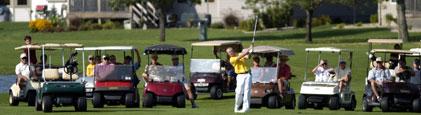
The Vermeers had a pleasant Sunday drive the rest of the
way. Like almost everyone else watching the final threesome,
they were in a cart. By the back nine there were dozens of
carts trailing the action, and they lined up in the
peripheral shade of the greens like people in their sedans
at a drive-in movie. It looked different, particularly when
they wheeled in a big pack up the 17th hole, but the
spectators were practically Masters-patron quiet when the
shots were being hit.
By the time everyone had parked for the day, Vermeer was
the man getting the $20,000 winner's check, while Eric
Bailey, a University of Wyoming golfer, received a green
jacket, a $500 merchandise certificate and a round of
handshakes for claiming the amateur division. Vermeer's
payday was twice as large as his biggest previous check,
which he earned on the Tight Lies tour, where he has been a
regular. As he choked up at the prize-giving, it was clear
the distinction meant more than the dollars.
"It's been a long time coming," said Vermeer. "I would
venture to say I've wanted to play the PGA Tour since I was
6 or 7."
The victory might finance a nicer honeymoon--he is
getting married Sept. 17--and give him more confidence come
Q school. For the moment, the feeling of being king for a
day made him in no rush to exit with his oversized cardboard
check, which wasn't quite as large as the ones the golfers
get on TV but which nonetheless was going to look quite
handsome on his wall.
There being no direct deposit, many of the players waited
around for their checks to be written. Kalinowski hung out
in the Hillcrest pro shop with Chris Galeski and Mike
Troyer, who were going to make the 366-mile drive from
Yankton to Rapid City together in Galeski's Ford Explorer.
The players milled around the shop and shot the breeze with
Hillcrest pro Pat Kramer. Kalinowski was due the runner-up's
share of $8,000. Small problem: the "eight" said "eighty."
Blotting out the "y" wasn't satisfactory, so Kalinowski
waited for someone to produce a mulligan. When he got it, it
was time for a quick pizza dinner before setting out.
"If you don't like to travel, you won't like this gig,"
says Galeski, a 25-year-old Californian with an uncanny
resemblance to Scott Verplank, circa 1986. Galeski had put
more than 3,000 miles on his car since leaving home bound
for the Great Plains.
The threesome made good time traveling west that night,
because on the open roads of the Dakotas, one doesn't tend
to dally. But Amos Rolon, his girlfriend, his dogs and his
bird weren't going to Rapid City. He was believed to be
headed in the opposite direction, perhaps toward a butcher
in Spirit Lake, Iowa, to buy some more of the best pork
chops he had ever eaten.
Bill Fields
|